BlogSecurity
Azure Day 2026 - Recap: Defender Orchestration Is Where Your Security Stack Earns Its Keep
Day One of the roadshow, closing remarks. (Fifth and final post in the series unpacking what we covered.)
After four hours of Azure foundations, modernization patterns, endpoint strategy, and a Defender for Cloud deep dive with Dustin, Mike, and Phil, I closed the day on the operational layer that turns the products into actual defense. The Defender suite earns its keep through the orchestration that sits on top of it. Most mid-market organizations own more Defender capability than they can operationally activate.
Castle defense, with towers you actually integrate
The way I framed it on the call is castle defense. Build high walls. Make them complete. Make sure they are designed natively to work together and communicate together. Then you can choose where to add a third-party tower, redundant capability, or an industry-specific tool for the use cases your business actually needs.
The Microsoft Defender stack (Defender for Endpoint, Defender for Identity, Defender for Office 365, Defender for Cloud Apps, Defender for Cloud, plus Entra and Intune as the identity and management plane underneath) was built to share signals natively. When you bolt a competing endpoint product, a competing identity product, and a competing email security product onto a Microsoft tenant, you give up most of the native cross-product correlation. The signals end up in your SIEM after the fact instead of correlating at the platform layer.
If you are using a Microsoft-licensed stack already, the Defender story is the one your security budget should be built around. Then you can vote with your dollars on where you want to add extra defense or features.
The operational machine is what most teams underestimate
Running these capabilities at the level modern threats require is a different operational discipline than turning them on. Three reasons most mid-market organizations cannot economically build a SOC internally. You need 24x7 coverage, which means three shifts of trained eyes. You need breadth and depth across the entire Defender surface area so signals can be correlated across email, endpoint, identity, cloud, and storage at the same time. And you need an automation discipline that turns "fool me once" into a permanent response, with humans verifying and restoring access on the edge cases that automation should not own alone. Not to mention that you have to defend from and learn from that “fool me once” every time you see it, you miss the shared learnings of a larger group.
Building an internal SOC for a mid-market organization that needs to defend a Microsoft 365 plus Azure footprint is increasingly hard to justify against a managed XDR partnership that brings the experience, the runbooks, and the cross-customer threat intelligence.
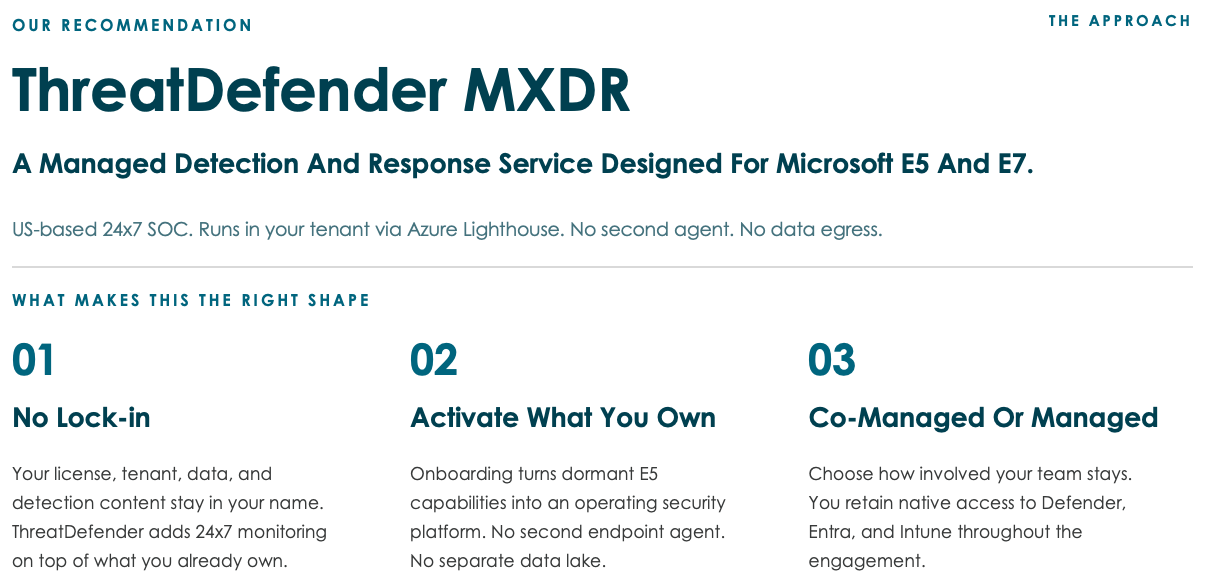
This is the conversation Threat Defender (our Microsoft-verified MXDR service) was designed for. Microsoft Intelligence Security Association membership, Microsoft Verified MXDR Partner, runbooks and automations built across the full Microsoft stack rather than retrofitted from a generic SOC.
How we built Threat Defender to avoid the common traps
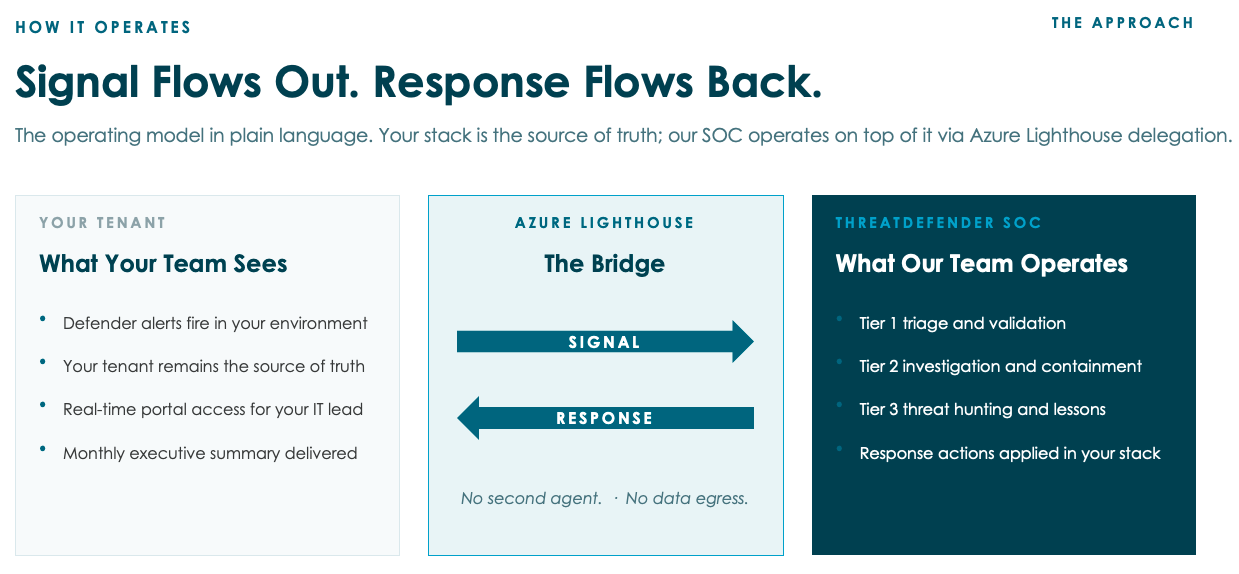
Two questions surface every time we scope MXDR. Threat Defender runs through Azure Lighthouse, the Microsoft-managed API bridge. Your data stays inside your tenant, in your Sentinel deployment, in your security.microsoft.com console. Our SOC sees the signals and injects responses across the API without your telemetry ever leaving your environment. If you ever replace us, your security stack stays in place.
The Lighthouse separation also runs the other direction. When we see a new attack pattern in one customer environment and build an automated response, that automation rolls to every Threat Defender customer. Your tenant inherits intelligence you would otherwise have to discover the hard way. The same API boundary keeps another customer's compromise from ever becoming yours.
Where this series leaves you
Across the five posts: Azure pays off when the foundation, the modernization patterns, the endpoint strategy, the security architecture, and the operational layer reinforce each other.
A practical sequence for the next 90 days: get the landing zone right (Post 1), pick three workloads to modernize this quarter and retire at least one of them (Post 2), map your endpoint personas to delivery models (Post 3), turn on CSPM and enable Defender for X by policy (Post 4), and decide whether MXDR is the better economic answer than building the operational layer in-house (this post).
If you want to walk through where your environment sits across any of these, scope a security review against your Azure estate, or model what a Threat Defender onboarding would look like in your tenant, reach out.
Working through the same problems?
Jason compares notes with IT leaders every week. Reach out on LinkedIn.